Jeremy knew the DMV by its sounds and smells.
Fluorescent lights warmed up with a thin electrical sigh. Vents pushed out stale cool air that carried printer toner, floor wax, and yesterday’s burnt coffee. Every few minutes, the front doors clicked as their lock mechanism checked itself, impatient with the passing time.
At five in the morning, the building belonged to Jeremy, the dust, and the long rows of plastic chairs waiting for bodies. His cart rolled softly over tile. On each turn, the mop handle tapped the bucket. Keys on his belt chimed in a small, familiar rhythm as he made his way down the hall.
By nine, noise took over. People arrived already irritated, already bracing for the slow grind of forms, numbers, and lines that never moved the way anyone wanted. In that crowd, the strange things learned how to hide. Ordinary frustration covered everything.
Quiet held its ground in the back hallway near the employee break room. The public rarely wandered there unless someone took a wrong turn and, with urgency and mild panic, searched for restrooms. The air stayed cooler in that corridor, the sounds softer, the light a shade dimmer.
That hallway held the vending machine.
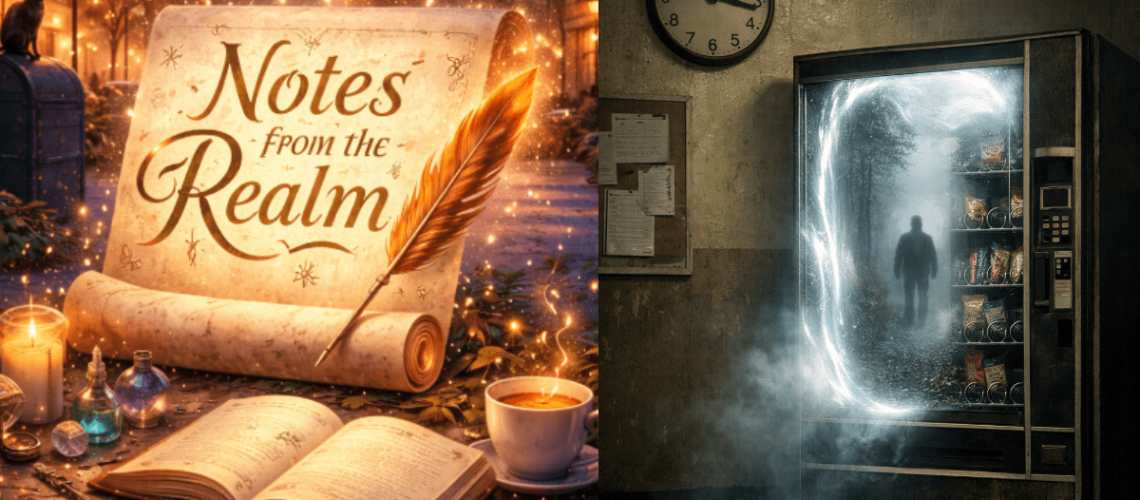
Its black metal frame stood scuffed and dented. Smudged glass reflected the overhead lights. Coiled spirals cradled snacks that no one truly wanted. A keypad glowed tired green while the machine hummed without variation, a sound that blended into the building so thoroughly it felt permanent.
Jeremy didn’t care about it until he noticed the crackers.
They sat in the third row from the bottom, second slot from the left. The peanut butter crackers came in a cheap cardboard box with one corner always dented. The label always tilted at the same wrong angle. People bought the dented package, and the spiral rolled forward, offering another. Jeremy never bought them. He watched them.
At 2:17 p.m. every weekday, the crackers reset.
They didn’t restock. They reset.
The dent reappeared. The label returned to its familiar tilt. Light reflected off the wrapper in the same narrow streak. Even the faint dust on the inside of the glass shifted into a pattern Jeremy recognized.
Jeremy tested every reasonable explanation first. Vendors restocked machines. Employees played pranks. Coincidence happened.
Then uncertainty set in.
A tiny dot of Sharpie on the wrapper vanished at exactly 2:17. A shallow scratch from his key disappeared the same way. He unplugged the machine overnight.
When he returned the next morning and plugged it back in, the machine powered on normally. The lights came up, the hum settled, and the snacks sat exactly where he’d left them. At 2:17 in the afternoon, the crackers returned to their dented perfection.
He mentioned it once to Andrea from Records while the coffee dripped in the break room.
“You know the vending machine by the hallway,” he said.
“The one that steals your money,” Andrea replied.
“It resets something every day at 2:17.”
Andrea smiled politely. “Jeremy, everything in this building resets people’s patience.”
He stopped talking about it.
He kept watching.
The day the portal opened, the building smelled like rain.
The scent didn’t belong inside a government office. It carried minerals and damp stone, green and clean. By 2:12, it thickened in the back hall, and the vending machine’s hum deepened until it throbbed along Jeremy’s jawline.
Jeremy stood there with his cart, hands tight around the mop handle, eyes fixed on the wall clock.
At 2:16, the lights flickered once. Cool dampness brushed his skin.
At 2:17, the glass bent inward.
It curved instead of breaking. Snacks blurred behind it, and the crackers stretched into a narrow corridor of shifting color.
Cold air spilled out, alive with the smell of moss and rain-soaked ground. Sound followed it, distant wind through trees, footsteps on gravel, and a soft chiming tone that vibrated low in Jeremy’s chest.
Jeremy stepped back as his heart hammered.
A voice came through the glass. “Hello?”
Jeremy swallowed, stooping to peer into the shifting color. “You shouldn’t be in there.”
“That’s helpful,” the voice said. “I pressed D2.”
“It resets,” Jeremy replied.
“I noticed,” said the voice.
When a pale hand pushed through the surface, fingers trembling, skin faintly luminous, Jeremy lunged for the breaker panel and flipped the emergency cutoff. The hallway went dark, and the hum died instantly. The cold air vanished, and the rain scent collapsed back into the walls.
“Wait,” the voice said, then cut off as the light went out.
Jeremy counted to sixty to steady himself. Then he flipped the breaker, and the lights came back on. The vending machine glowed steadily. The glass looked solid again. The crackers waited behind it, dented and familiar. No voice called to him. No hand remained. He leaned against the wall until his breathing slowed, then filed an incident report noting flickering lights and cold drafts. By morning, the report was gone from the system.
The next day, he returned to the hall at 2:15. The rain scent returned, and the hum deepened. This time, he meant to catch it. At 2:16, he turned on his phone’s video recorder and propped it up in the hallway at an angle to capture the entire vending machine. At 2:17, the glass bent again.
On this occasion, the tunnel opened wider, revealing a road. Pale gravel curved through tall trees whose leaves caught light like brushed metal. The sky beyond glowed muted gray-green. Cold, living air poured into the hallway. A figure stood in the road, waving, as if he could see him.
Jeremy heard footsteps close behind him and went still before turning.
A woman in a damp trench coat stood clutching a manila folder. Water clung to her sleeves and hair. Her eyes darted between the clock and the glass. Then her free hand lifted uncertainly toward the machine.
Jeremy shifted slightly to block her. “Stop. Don’t touch it,” he blurted.
She hesitated, then lowered her hand and hugged the folder closer.
He nodded toward the glass. “Is that someone you know?”
Her breath caught. “Yes. My brother.”
Jeremy kept his voice even. “What’s his name?”
“Eli,” she said. “Eli Morales.”
The figure paced nervously.
Jeremy nodded once. “And you?”
She swallowed. “Elena.”
Jeremy looked back at the glass. “Okay,” he said, as if saying it might clarify things. “If that’s your brother, he needs help.” Then he held up a hand. “That doesn’t mean we do anything yet.”
The woman nodded, tears slipping free. “But we have to do something.”
Jeremy didn’t answer right away. He kept his eyes on the road beyond the glass, measuring the distance, the light, the way the figure stood waiting.
“Yes,” he said finally. “We do.”
Then he raised his voice and spoke to the man on the road. “Hold up three fingers.”
Three of the man’s fingers rose.
The woman gasped.
“Do you know this woman?” Jeremy asked.
Elena leaned in close.
“Yes, of course,” Eli said. “That’s my sister, Elena.”
Jeremy nodded once. “That’s him.”
When the vending machine shuddered and the lights pulsed, Jeremy moved to the breaker and flipped it off again. The hallway fell into darkness, and the tunnel collapsed inward. When he turned the breaker on, he saw the glass had sealed.
Elena’s voice shook, strained from holding it together. “I almost rushed forward.” She pressed the folder tighter to her chest, knuckles whitening. “If I’d touched it…who knows what would have happened.”
Jeremy nodded, a tremor running through his hands.
“But you didn’t,” he said, keeping his voice steady. He retrieved his phone and held it up so she could see the screen. “And now we have something we didn’t have before.”
She followed his gaze, her eyes tracking the paused video frame, the warped reflection of the hallway frozen mid-bend.
Jeremy moved carefully after that. He saved the video twice before his hands steadied. He recorded everything in a small supply notebook, trusting paper more than any system. He noted the time, the smell, the way the glass bent, the exact sequence of questions and responses.
Elena watched him the whole time, silent now, her breathing still uneven as he worked.
“I’ll report this,” he said, matter-of-fact but low. “We should stay in contact.”
“Okay,” she said, stepping forward without hesitation to give him her number.
Jeremy typed it into his phone and sent her a text so she’d have his.
“Thank you,” she said, sounding steadier than she looked. Then she turned and walked away.
Jeremy logged the report, sure it would gain traction this time. The pushback came later.
Facilities called it a malfunction. Administration suggested coincidence. The first report vanished the same way the other one had. Jeremy refused to let it end there. He escalated, documented, and stayed present in ways he never had before. He learned which offices answered faster when you didn’t soften your language.
A month of dead ends passed before three people dressed in black suits showed up. They hadn’t given titles or names, only a quick flash of a badge. Plastic sheeting went up, and for two days, the back hallway was closed under the excuse of electrical maintenance. When the Badges finally emerged from their makeshift tunnel, they slowly rolled the vending machine out on a handcart, wrapped in thick padding, as you would handle something that might be dangerous.
A week passed.
Then early one morning, Jeremy’s phone rang, waking him from a deep sleep. He fumbled on the nightstand until he found it. The name on the screen made him pause. He swiped to accept and brought the phone to his ear.
“Elena?” he said, yawning through it.
“They’ve figured out how to maintain contact,” she said without preamble. Her voice sounded different, steadier but not lighter. “Not through the machine. Through the time pattern around it.”
Jeremy rolled over and rubbed his eyes.
“They think they can bring him back,” she continued. “They won’t promise it. But they’re trying.”
He took a deep breath and let it go. “That’s great news.”
“Yes,” she replied. “It is. And I wanted to thank you…for everything.”
“Sure,” he said, not really knowing what to say.
The line went quiet with a soft click, and Jeremy returned the phone to the nightstand.
He remained in bed, unable to sleep, listening to the hum of his refrigerator and the distant traffic through the open window. His mind kept circling back to the vending machine, to the way it reset itself without caring who watched or why. He wanted to know how it worked, who built it, and why it had chosen that hallway, even though he already knew none of that was information he would ever be given.
The next week passed slowly. Jeremy returned to work each morning before the building filled. As part of his route, he walked the back hallway, checking lights, vents, and doors the same way he always had. The space where the vending machine had stood stayed empty, the floor cleaner than the surrounding tiles.
On Thursday afternoon, he paused at the spot and glanced up at the wall clock.
It read 2:17.
Nothing changed.
The lights stayed steady. The air stayed dry. The hallway remained a hallway.
Jeremy stood there for a moment longer, then pushed his cart forward and went back to work.
Important: This post is intended for informational and entertainment purposes only. It is not a substitute for professional advice in areas such as legal, financial, medical, or therapeutic matters. Always consult with your qualified [doctor, lawyer, CPA, therapist, nutritionist, etc.] before applying any information from this post to your personal situation. Thank you!